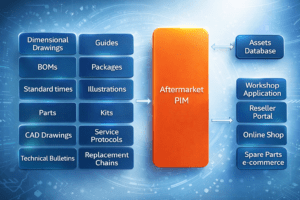
In the aftermarket, dealers are on the front line of customer experience. Their ability to quickly identify and deliver the right spare parts directly impacts uptime, service quality, and customer trust. Yet in many organizations, dealers still operate with incomplete or generic parts information, often based on product families rather than the actual machines installed in the field.
The challenge is straightforward: spare parts recommendations are only as good as the data behind them.
From Generic Catalogs to Installed Reality
Traditional spare parts catalogs are typically structured around product models or static BOMs. While useful, they rarely reflect the real-world complexity of delivered equipment. Each machine in the field is tied to a specific configuration: options selected, components installed, and changes made over time.
When dealers rely on generic views, they risk selecting parts that are incompatible, outdated, or suboptimal. This leads to delays, returns, and unnecessary service interventions.
Grounding Recommendations in the Install Base
High-quality spare parts recommendations start with understanding the install base. This means linking each delivered unit to its exact configuration: how the product was built, what components it includes, and how it has evolved through maintenance and upgrades.
When this connection exists, recommendations become precise. Dealers can see exactly which parts apply to a specific machine, including valid alternatives, supersessions, and service kits. Instead of searching broadly, they are guided by context.
Connecting Systems to Deliver Value
In practice, this requires connecting multiple sources of information. Product and configuration data may reside in engineering or PIM systems, while asset and service history live in ERP or service platforms. Bringing these together creates a complete view of each installed unit.
With this foundation, spare parts recommendations can be delivered directly into dealer-facing channels, whether in portals, workshop applications, or e-commerce platforms. The result is not just better information, but better decisions at the point of service.
Turning Recommendations into a Competitive Edge
When dealers consistently get the right recommendation the first time, the impact compounds. Lead times shrink, service efficiency improves, and customer confidence increases. Over time, this shifts the perception of the OEM from a parts supplier to a reliable service partner.
In a market where products are often comparable, the ability to support the install base with precision becomes a differentiator. Configuration-driven recommendations are not just about accuracy; they are about enabling a faster, more reliable aftermarket operation that scales with the complexity of real-world installations.