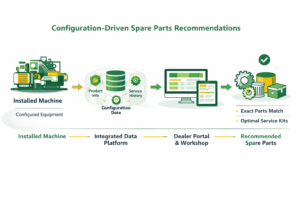
Configured products are often a commercial success. They offer flexibility at the point of sale and allow customers to tailor products to their needs. In the aftermarket, however, that same flexibility becomes a source of complexity. Once a product is in the field, it is no longer an abstract configuration — it is a specific, configured unit with history, constraints, and service expectations. Supporting that reality requires more than traditional product data management.
An aftermarket-focused Product Information Management (PIM) system provides the necessary foundation. It acts as the central source of truth for product structures, configuration and options logic, and compatibility, enabling consistent support across service, spare parts, and dealer channels. This principle is central to Signifikant’s aftermarket platform, where product data is designed to support long lifecycles rather than just initial transactions.
Configuration as a Long-Term Discipline
In the aftermarket, configuration complexity is amplified by time. Products evolve, components as well as configurations and options are discontinued or replaced, and legacy configurations remain in operation for years or even decades. The challenge is not just knowing what can be configured today, but understanding what was configured when a product was built and how it is maintained today.
A PIM-first approach addresses this by modeling product families, assemblies, and configurations and options in a structured and historically aware way. Instead of flattening configurations into an ever-growing list of SKUs, it preserves the logic behind them. This allows aftermarket organizations to support older equipment accurately while still introducing new configurations in a controlled manner.
Serial Numbers and Reality in the Field
Serial numbers form the bridge between product data and physical reality. They represent the individual instance of a configured product operating in the field. While serial-level lifecycle data typically resides in ERP, service, or asset management systems, PIM provides the configuration blueprint that makes this data meaningful.
By linking serial numbers to their original and even maintained configuration, aftermarket teams can determine which spare parts, documentation, and upgrades apply to a specific unit. This linkage is essential for reducing errors, improving first-time fix rates, recommending parts to keep in local stock and supporting both as-designed and as-maintained product states throughout the product lifecycle.
Findability and Spare Parts Accuracy
In the aftermarket, accurate spare-parts identification is critical. Incorrect parts lead directly to downtime, returns, and frustrated customers. Configuration-aware product data is the difference between guesswork and precision.
Filtering and findability play a central role here. Aftermarket users rarely browse; they search with intent, often starting with incomplete information. A well-structured PIM model ensures that attributes, relationships, and configuration rules work together to guide users quickly to the correct parts, documentation, or service information — even for complex or aging products.
Turning Complexity into an Aftermarket Advantage
From an aftermarket PIM provider’s perspective, handling configured products is ultimately a strategic discipline. The goal is not unlimited flexibility, but controlled, meaningful variability aligned with service processes, parts logistics, and long-term lifecycle support.
Platforms like Signifikant’s aftermarket solution are built around this idea: making configuration logic explicit, governable, and reusable across channels. When configuration is treated as shared product knowledge rather than technical overhead, complexity becomes a scalable advantage — and a foundation for stronger, more reliable aftermarket experiences.