
Most manufacturing profit and loss statements tell a misleading story. The spotlight is on the initial sale, while the real, resilient value often sits quietly in service contracts, spare parts, and long-term support. Over time, that “support function” becomes the revenue line leaders rely on when markets slow down or new product launches are delayed.
What changes this reality is not another tool or channel. It is when leadership starts treating the aftermarket as a core business in its own right. That means setting explicit profitability targets, giving it a clear strategy, and applying the same discipline to data, pricing, and customer experience that the organisation applies to new product development.
In many OEM conversations, there is a recognisable moment. Someone realises that the most predictable, high-quality revenue is coming from the installed base, not from the next big launch. Margin analysis confirms what teams have sensed for years: when the aftermarket is structured and visible, it carries the business through cycles.
But visibility does not happen by accident. It starts when leaders ask very simple, uncomfortable questions:
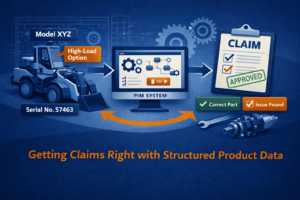
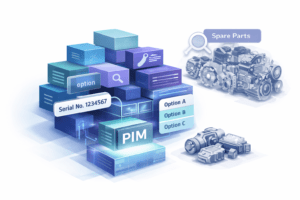
“Can we see, today, exactly which parts and documents apply to each machine in the field, by serial number and configuration?”
“Can we give accurate recommendations to our customers on what parts to keep on local stock?”
“Can we support our major customers in what parts are in their fleet or installation?”
“Can major customers access our parts data through seamless APIs?”
“Do we know which parts we must keep producing to meet regulatory requirements?”
Those questions alone often reveal how much revenue and goodwill are quietly leaking out of the business.
A second shift is realising that every small information gap has a cost. One missing relation between old and new parts, one undocumented design change, or one outdated PDF can be the reason a technician orders the wrong item, a machine stands still for another day, and a customer starts looking at third-party options. When leaders treat these issues as business risks rather than operational noise, they start to invest differently in catalogue ownership, governance, and cross-functional accountability.
And increasingly, they are asking whether intelligence can be built into these systems over time. Not as a product feature, but as a capability the organisation may choose to develop. Across the industry, AI is beginning to influence how companies improve service experience, better the quality of parts data or help organizations analyze large volumes of aftermarket data to increase quality and revenue.
The important question for leadership is not adoption, but intent: how deliberately these possibilities are explored as part of a longer-term aftermarket strategy.
The final step is to manage the aftermarket like a business with its own levers, not as a support extension of product sales. That means reviewing contribution margin by installed base segment, treating uptime and first-time-fix as board-level metrics, and making it visible when customers stay or leave because of service quality rather than price.
Once that view is in place, the aftermarket becomes the place where customers vote, every day, on whether the company has earned the right to their next decade of business.