The journey from errors to data-driven decisions
Claims quality is a critical driver of aftermarket performance. Warranty claims, returns, and service disputes all depend on one factor: how accurately you understand the product in the field.
In reality, products are never generic. Every delivered unit reflects a specific machine, model, and configuration. Even within the same base model, variations in options or components can significantly impact performance. When claims are handled at a model level rather than a configuration level, errors follow – from incorrect approvals to unnecessary replacements and missed root causes.
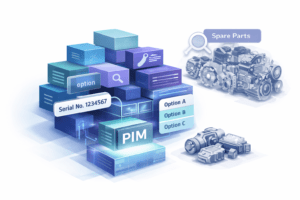
This is where structured product data becomes essential. A Product Information Management (PIM) system provides a consistent foundation for product models, configurations, and relationships. Instead of relying on fragmented data, claims processes can be anchored in a single, trusted representation of how products are built.
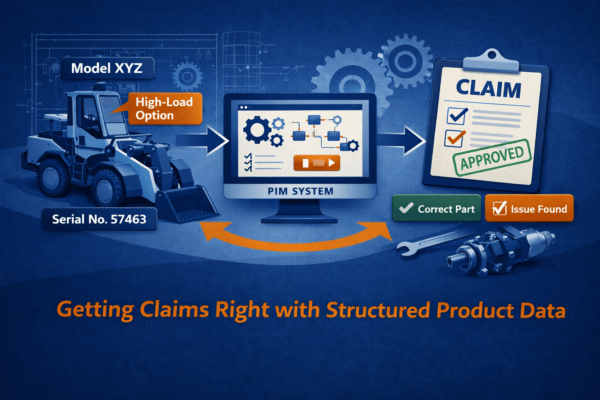
Consider a warranty case involving repeated hydraulic pump failures. If evaluated only at the base model level, a replacement may be approved and shipped, yet the issue persists. The root cause may be a high-load configuration requiring a different pump variant. Without configuration awareness, the process becomes trial and error.
With PIM, the claim can be evaluated against the exact configuration of the machine. The correct part can be identified immediately, compatibility constraints are clear, and known issues tied to similar configurations can be surfaced. What would have required multiple iterations becomes a precise, data-driven resolution.
Improving claims quality is not just about handling cases faster. It’s about preventing them. When configuration data is structured and connected to service and parts information, organizations gain visibility into recurring issues, supplier performance, and product weaknesses.
At Signifikant, we see claims quality as a direct outcome of structured product information. With PIM as the foundation, claims shift from reactive handling to informed decision-making: reducing costs, improving accuracy, and strengthening the entire aftermarket feedback loop.