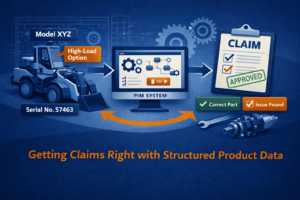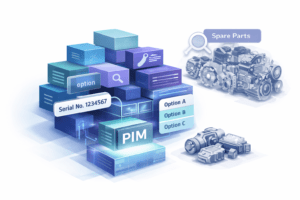
In the aftermarket, value is not created around products alone; it is created around assets in its use. What matters is not what was sold, but what is actually installed, how the product was configured, and how it is maintained in the field.
For many industrial OEMs, this reality is complex. Each customer site represents an install base made up of delivered projects, often consisting of multiple integrated configured products combined into a larger solution. Over time, these installations evolve through upgrades, replacements, and service interventions. At the same time, information about produced machines, configurations, maintenance and services history is often spread across multiple information systems. Without a clear way to connect and manage this complexity, visibility is lost.
From Products to Installations
Traditional product data models focus on individual items: machines, components, or spare parts. But in the aftermarket, these elements rarely exist in isolation. They are part of an installation, a functional system, delivered as a project.
An installation might include several configured machines, each with its own options and variations, working together as a complete solution. Understanding this structure is critical for service, support, and parts management. It shifts the perspective from “what products do we have?” to “what is installed and how does it work together?”
The Role of the Install Base
The install base is the foundation for all aftermarket activities. It represents the total population of assets in the field across customers, sites, and geographical regions.
A well-structured install base allows organizations to:
- Identify exactly what is installed at each customer site
- Understand the integration between the individual assets
- Understand configurations at a system level
- Track lifecycle events such as upgrades, replacements, and maintenance
- Enable accurate spare parts and service recommendations and planning of the preventive maintenance.
Without this, aftermarket operations rely on assumptions rather than facts.
Delivered Projects and Configuration Complexity
Most installations originate from delivered projects. These projects bundle multiple configured products into a single customer solution. While this works well at delivery, the structure often becomes fragmented over time as data is stored across different information systems.
The challenge is preserving the relationship between:
- The project (what was delivered)
- The assets (what is installed)
- The configurations (how each unit was built)
Maintaining these links is essential for understanding the full context of an installation.
Combining Configured Products into a Solution
Configured products introduce another layer of complexity. Each asset within an installation may have unique options, components, and constraints. When combined, they form a system where dependencies matter for performance, compatibility, and service.
Managing this effectively requires:
- Structured configuration data
- Clear relationships between assets and components
- The ability to view both individual units and the full installation
This is where a PIM-based approach becomes valuable. By structuring product and configuration data centrally, it becomes possible to connect that logic to real-world assets and installations.
Operating Across a System Landscape
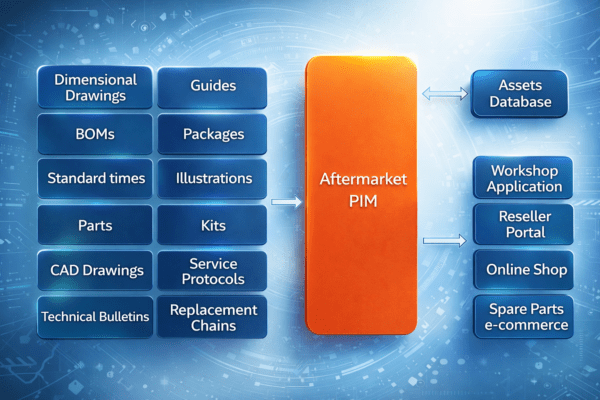
Managing assets and installations is not about replacing existing systems. It is about connecting them. Data about produced machines may reside in ERP or PLM systems, configuration logic in product data platforms, and maintenance history in service or FSM systems.
An effective aftermarket solution must operate within this system landscape, integrating with these systems to create a complete and consistent view of the install base. Without this integration, information remains siloed, and the full context of an installation is never fully visible.
From Visibility to Value
When assets, configurations, and lifecycle data are connected, organizations gain more than visibility. They gain control.
They can:
- Improve service planning and execution
- Ensure correct spare parts identification across entire systems
- Support upgrades and retrofits with confidence
- Build stronger, long-term customer relationships
At Signifikant, we see assets and installations as a natural extension of structured product data. By connecting configured products, delivered projects, and the install base across systems, aftermarket organizations can move from fragmented information to a complete, reliable view of what exists in the field.