Across more than 40 conversations at four events this autumn, one message was clear: the aftermarket has moved from a back-office task to a revenue priority, but the tools behind it have not kept up.
Over the past two months, the Signifikant team has been at LogiAftersales in Amsterdam, Parts Summit at Frankfurt, Elmia Lantbruk in Jönköping and Scanauto in Göteborg. We spoke with manufacturers across industries, geographies, and from family-owned specialists to global groups. Their products differ, but the questions they asked us were strikingly similar. Here is what we heard, and what we think it means for the times ahead.
Problems we heard again and again
1. The aftermarket is a priority, but many have no system for it
Almost everyone agreed that service and spare parts are where the margin is. Several said outright that they depend too heavily on new-machine sales and need to grow aftermarket revenue. Yet a surprising number of manufacturers, including well-established ones, still have no digital system for parts and service at all. Some told us the real starting point is even earlier: the spare parts data itself is not yet in a usable shape.
2. Home-built tools are reaching their limits
Many companies have tried to solve the problem themselves. We met teams running in-house portals, basic webshops built by one group company, and even an engineer coding solutions on the side because the existing system falls short. Others have bought a platform whose rollout has dragged on, leaving gaps in key markets. The question has shifted from “can we build this?” to “should we keep building this ourselves?”
3. Customers buy installations, not just machines
Manufacturers that deliver production lines, plants and complete systems told us their customers think in installations. A service engineer on site wants to see everything that was delivered to that line, not browse a catalogue of every product the company makes. One visitor called installation-level information “e-catalogues on steroids”.
4. Catalogue, webshop and ERP should be one journey
Finding the right part is only half the job. Buyers want to go from an exploded view to a price, an availability check and an order without switching systems. Several companies were looking at catalogue and webshop together, and some were in the middle of an ERP change that makes this a natural moment to rethink the whole flow.
5. New tools must work with existing systems
Larger groups already have ERP, PLM and service platforms they are not going to replace. What they need is an aftermarket layer that connects to those systems and takes data from them automatically, rather than another island that needs manual upkeep.
How Signifikant addresses these pain-points
Signifikant is built for exactly this moment: a ready-made aftermarket platform, so manufacturers can stop maintaining home-built tools and focus on growing their service business.
A platform instead of another in-house project. Parts catalogues, documentation, search, permissions and publishing come ready to use and are configured to each company’s brand and business model. Teams spend their time on content and customers, not on keeping software running.
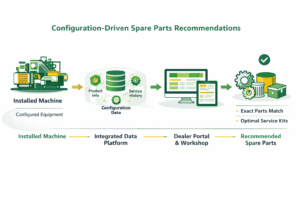
Information for the machine in front of you. With serial-number lookup and asset records, the catalogue filters down to the parts that actually belong to one specific machine. It shows the machine as built and as maintained, including every recorded modification, so customers order the right part the first time.
Whole installations in one view. Our new Projects capability groups every product, document and spare part delivered to a site, line or plant into one context. Search and navigation are automatically limited to that installation, and each customer sees only their own projects.
From catalogue to order. Catalogues connect to webshops and ERP systems for live prices, availability and ordering. Orders can be routed to a webshop, a dealer network or straight into the ERP, depending on the customer.
Built to connect. Open APIs and automated imports from SAP, PLM systems such as Windchill, and other sources keep the aftermarket data in sync with the systems a company already runs. Each field has one master system, so nothing is maintained twice.
A faster start for those still building their data. Our AI-supported import turns PDF parts manuals and exploded-view drawings into structured, hotspotted catalogues in hours instead of weeks. An editor reviews everything before it is published. AI translation with a translation memory then keeps the content consistent across languages.
Leading manufacturers of industrial equipment, construction machinery and agricultural machinery already run their aftermarket information on Signifikant.
What’s next
The conversations also pointed beyond sales and service. As products stay in use longer and get remanufactured, reused and recycled, accurate product and asset information becomes the backbone of circular manufacturing too.
That is the topic of our upcoming webinar with C-eco, where we share our work in DiCiM, the Horizon Europe project on digitalised value management for circular manufacturing systems.
If you’d like the short version of what Signifikant does, have a look at our datasheet here
And if we met you at one of the events this autumn, thank you for the conversations. If we didn’t, we’d be glad to hear how your aftermarket is evolving. Get in touch with us at info@signifikant.se